

Ancient Road Publications |
 |
|
Beer in the Bible? By Kyle Pope W hen
I was a little boy it was understood among most members of the church that
Christians do not drink alcohol.[1]
Now, not only within the church, but in our world as a whole there is a
concerted effort to move religiously minded people to view drinking as acceptable.
In popular culture, we turn on our radio and hear country musician Miranda
Lambert telling us, “I heard Jesus he drank wine and I bet we’d get along just
fine” (A Heart Like Mine). Ancient Israelites, with the possible exception of a few teetotaling Nazirites and their moms, proudly drank beer—and lots of it. Men, women and even children of all social classes drank it. Its consumption in ancient Israel was encouraged, sanctioned and intimately linked with their religion. Even Yahweh, according to the Hebrew Bible, consumed at least half a hin of beer (approximately 2 liters, or a six-pack) per day through the cultic ritual of libation, and he drank even more on the Sabbath (Numbers 28:7–10) (Biblical Archaeology Review 36. 5 [Sept./Oct. 2010] 49). What motivates such a zealous push to make drinking seem normal and even wholesome? As Christians, we must confront the more fundamental issue of whether such claims harmonize with the teaching of Scripture or not. Scripture
speaks often of “wine” using words that can refer to the product of the grape
at any stage from grape juice to vinegar.[2]
The student of Scripture will find, however, that most translations have no
reference to “beer” (e.g. KJV, ASV, RSV, NASB, NKJV, ESV). Only less literal
translations such as the New International Version, the Holman Christian
Standard Bible, and the Contemporary English Version refer to “beer” at all.
So why would Homan, and these translations speak of beer? Homan’s argument is an over-simplification that rests primarily on his desire to narrow the definition of the Hebrew word shekar to mean “beer” exclusively. The Old Testament used the word shekar twenty-three times.[3] In every case, except two (Num. 28:7; Ps. 69:12), it is used in some type of parallelism as in the phrase “wine and strong drink (shekar).” Once, in the New Testament, this word is brought into Greek in the same sense, in the command that John would “drink neither wine nor strong drink (sikera)” (Luke 1:15). One of the first definitions of this word is offered by Methodius of Olympus (who died ca. 311). He called it an “artificial wine” made from “date-palms and other fruit trees” (A Treatise on Chastity 5.6). After him, Jerome (ca. 342-420) claimed: Shekar in the Hebrew tongue means every kind of drink which can intoxicate, whether made from grain or from the juice of apples, or when honey combs are boiled down into a sweet and strange drink, or the fruit of palm oppressed into liquor and when water is colored and thickened from boiled herbs (Epistle to Nepotianus, 266). In the same way, every major Hebrew lexicon defines this word broadly.[4] Shekar probably included drinks made from grains, but the evidence suggests that “beers” were not as common in Israel as in Egypt and Mesopotamia. The Babylonian Talmud claimed that storehouses of beer in Babylon were like the storehouses of wine in Palestine (Pesachim 8a). Even in Palestine, Broshi associates beer drinking more with the Philistines than with the Israelites, because of the type of vessels discovered among the Philistine ruins—jugs with a spout and a strainer for filtering the chaff (165). Homan bases much of his argument on the etymological connection between the Heb. shekar and the Akkadian word shikaru which he exclusively defines to mean “barley beer” (52). Yet, even the word shikaru in the Assyrian Dictionary (which he cites) can be used of “date wine” or “fig wine” as well (Vol. 17, p. 428). What seems most likely is that both words refer to strong drinks in general with more of an emphasis on “beer” in Mesopotamia and less in Palestine. 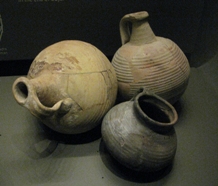 So why is it important to emphasize this distinction? First, because Homan, (like so many modern writers), over-simplifies the issue. A reader who accepts his argument without question might put down his article, drive to the liquor store and get his own “six-pack” of Budweiser or Coors, convinced he could do so with the sanction of God. Yet, the fact is that most of the twenty-three instances of the use of shekar speak of it negatively. In those cases where this is not the case, the student of Scripture must understand that what the ancients called “beer” was not the same as modern “beer.” Six years before Homan’s article ran, he published an expanded version of virtually the same article in Near Eastern Archaeology. In that article, Homan acknowledged that beer made by the ancient method he describes with bread soaked in water for a few days had an alcohol content of only 2-3% as opposed to modern beers of 5% and above (“Beer and Its Drinkers: An Ancient Near Eastern Love Story.” 67:2 (2004) 91). Ancient beers were often mixed with dates, honey, or spices and consumed by both adults and children. Babylonian and Egyptian reliefs show beer drinkers using straws or strainers because ancient beers retained the chaff and husks from the barley. Xenophon describes drinking such beers with straws for this purpose and even mentions that the strength of such drinks could be diminished further by adding water (Anabasis 4.5.26-27). This makes it clear we are not talking about the same thing someone might purchase at the liquor store today. A second reason this distinction is important is because Homan asserts that the shekar used for the drink offering of Number 28:7-10 was “beer.” There are a number of problems with this. First, Leviticus 2:11 prohibited offerings on the altar that contained “leaven.” Two words are translated “leaven”: chametz and seor. Both words are included in this prohibition. David J. Jordan, in his doctoral thesis, An Offering of Wine: An Introductory exploration of the role of wine in the Hebrew Bible and ancient Judaism through the examination of the semantics of some keywords, writes: Beer is fermented grain, or, often in the ancient world, fermented bread. Thus, as shakar was sacrificed on the altar it could not refer to beer in Biblical Hebrew, as beer is leaven and cannot be sacrificed on the altar. Similarly, banned from being sacrificed on the altar was debash (Lev 2.11). BDB defines debash, as honey including fruit honeys. Thus, date wine (a product of date honey) and mead could not be sacrificed on the altar (Doctoral Thesis, The Department of Semitic Studies, University of Sydney, 2002, p. 122) The Talmud considered beer made from barley “leavened”—chametz (Pesachim 42a-b), and considered barley one of five grains subject to chametz restrictions (Menachoth 70a-b). This makes it highly unlikely that shekar was (as Homan argues) “barley beer.” If Jordan is right, that date-wine would also be prohibited, what was the shekar of Numbers 28:7-10? The Dead Sea Scroll known as The Temple Scroll, in a probable reference to the drink offering, declares, “pour out a libation of shekar, new wine, on the altar of the Lord, year by year” (11QT 21.10). The Mishnah considered wine forty days old suitable for use as a drink offering (Eduyoth 6.1) although some rabbis argued that wine straight from the vat could be used (Baba Bathra 97a). This would suggest that the shekar of Numbers 28:7 was “new wine”—not beer.  If this is the case, it poses a few problems itself. Fermented wine was considered “leavened” by at least some of the Jews. A conservative sect known as the Karaites, to this day argues of the Heb. word for leaven, “Chametz comes from the Heb. word meaning sour as is therefore any edible food that has gone through a souring process, in other words a substance that has fermented. This includes…beers and all alcoholic drinks including wines, for to produce alcohol fermentation has to occur” (The Biblical Passover Haggadha, by the Meir Yosef Rekhavi, 8). Karaites use juice squeezed from rehydrated raisins (called “raisin wine”) for the Passover (ibid. 7). Broshi cites a potsherd discovered at Lachish that identifies its former contents as “wine made from black raisins” (152). This could suggest that shekar (like other Heb. words for wine) might have referred to drinks that were fermented or unfermented.[5] Whether we are talking about ancient beers or wines, Christians need to understand that to compare modern drinks (usually containing added sugars, yeasts, or even distilled alcohol to boost alcohol content) with ancient drinks is “comparing apples to oranges.” Broshi, after imagining how an ancient Israelite would react at our dinner table, writes, “we too, had we chanced to sit down at his table, would probably have been amazed at the fact that wine was only consumed mixed with water” (161). He goes on to cite evidence of wine diluted as much as 1 part wine to 20 parts water! Clearly, this is not what we call “wine.” Ancient people knew how to impede fermentation (to some degree) but still called both fermented and unfermented drinks by the same names. The Bible condemns more about drinking than just drunkenness alone (1 Peter 4:3-5). Christians, as priests of God (Lev. 10:9-11; 1 Pet. 2:4-9), set apart unto God (Num. 6:1-4; Rom. 1:7), are called to a higher level of readiness and sobriety than even men and women of the past. With all of this, in a world in which we are given such an abundance of choices of drinks that in no way compromise our salvation, influence, judgment, or self-control—why would we choose drinks that do? [1] Such views on abstinence are attested as early as the second century. Clement of Alexandria wrote, “I therefore admire those who have adopted an austere life, and who are fond of water, the medicine of temperance, and flee as far as possible from wine, shunning it as they would the danger of fire” (The Instructor 2.2 “On Drinking”). [2] For more on this see my article “Social Drinking—It’s Okay, Right?” Biblical Insights, 10.4 (April 2010): 20-21. Online: http://www.ancientroadpublications.com/Studies/BiblicalStudies/SocialDrinking.html [3] Lev. 10:9; Num. 6:3[twice]; 28:7; Deut. 14:26; 29:6; Jud. 13:4; 13:7; 13:14; 1 Sam. 1:15; Ps. 69:12; Prov. 20:1; 31:4; 31:6; Isa. 5:11; 5:22; 24:9; 28:7 [3 times]; 29:9; 56:12; Micah 2:11. [4] “Strong drink, any intoxicating liquor whether wine…or an intoxicating drink resembling wine prepared or distilled from barley” (Gesenius, 1064). “Intoxicating drink, Strong drink” (BDB 1016). “Beverage, beer, strong drink” (Koehler and Baumgartner, 972). “Strong drink, beer” (TWOT 2.927). [5] The biggest problem with this possibility is that skr the verb from which shekar is derived, almost always refers to intoxication. Rabbinical Jews do not believe that grapes and liquids produced from grapes fall under leaven restrictions. |
 Or, Mark Chesnutt, echoing the same thought,
singing, “I hear that he can turn the water to wine. Any man that can do that,
oh he’s a good friend of mine. I’ve been baptized in beer, I’m here to testify,
I was speaking in tongues when I came home last night. Some folks say I’m
living in sin but I know the Lord loves the drinking man” (The Lord Loves the Drinking Man). This may not surprise us from country musicians, but even in scholarly circles we
see folks like Thomas R. Sinclair (professor of crop science at North Carolina
State University) and his wife, researcher Carol Janas Sinclair, in their book Bread,
Beer and the Seeds of Change: Agriculture’s Imprint on World History, trying
to persuade the reader that Noah was a beer merchant (Cambridge: CABI, 2010, p.
66). Or, Michael Homan (associate professor of Hebrew Bible at Xavier
University of Louisiana), in his article
Or, Mark Chesnutt, echoing the same thought,
singing, “I hear that he can turn the water to wine. Any man that can do that,
oh he’s a good friend of mine. I’ve been baptized in beer, I’m here to testify,
I was speaking in tongues when I came home last night. Some folks say I’m
living in sin but I know the Lord loves the drinking man” (The Lord Loves the Drinking Man). This may not surprise us from country musicians, but even in scholarly circles we
see folks like Thomas R. Sinclair (professor of crop science at North Carolina
State University) and his wife, researcher Carol Janas Sinclair, in their book Bread,
Beer and the Seeds of Change: Agriculture’s Imprint on World History, trying
to persuade the reader that Noah was a beer merchant (Cambridge: CABI, 2010, p.
66). Or, Michael Homan (associate professor of Hebrew Bible at Xavier
University of Louisiana), in his article  This is not because beer is a modern invention. Archaeology reveals that beers
from barley (and other grains) go back into man’s earliest history. Magen
Broshi, in his book Bread, Wine, Walls, and Scrolls, in his section
“Wine in Ancient Palestine,” explains, “…the Middle East of antiquity was
divided into two main sections: wine-consuming countries and beer-consuming
countries. The latter were situated in the great alluvial valleys—Mesopotamia
and Egypt—whereas in all other areas wine was the main alcoholic beverage”
(145). Yet, since the focus of Scripture revolves around Israel, it is no
wonder that we read more about wine and little (if anything) about beer.
This is not because beer is a modern invention. Archaeology reveals that beers
from barley (and other grains) go back into man’s earliest history. Magen
Broshi, in his book Bread, Wine, Walls, and Scrolls, in his section
“Wine in Ancient Palestine,” explains, “…the Middle East of antiquity was
divided into two main sections: wine-consuming countries and beer-consuming
countries. The latter were situated in the great alluvial valleys—Mesopotamia
and Egypt—whereas in all other areas wine was the main alcoholic beverage”
(145). Yet, since the focus of Scripture revolves around Israel, it is no
wonder that we read more about wine and little (if anything) about beer. |
Pope, Kyle. "Beer in the Bible?" Focus Magazine No. 119 (October-November 2011): 18-21 |

|
Home Studies Outlines Photos Graphics Fonts Books Tracts Hymns Contact Us |
